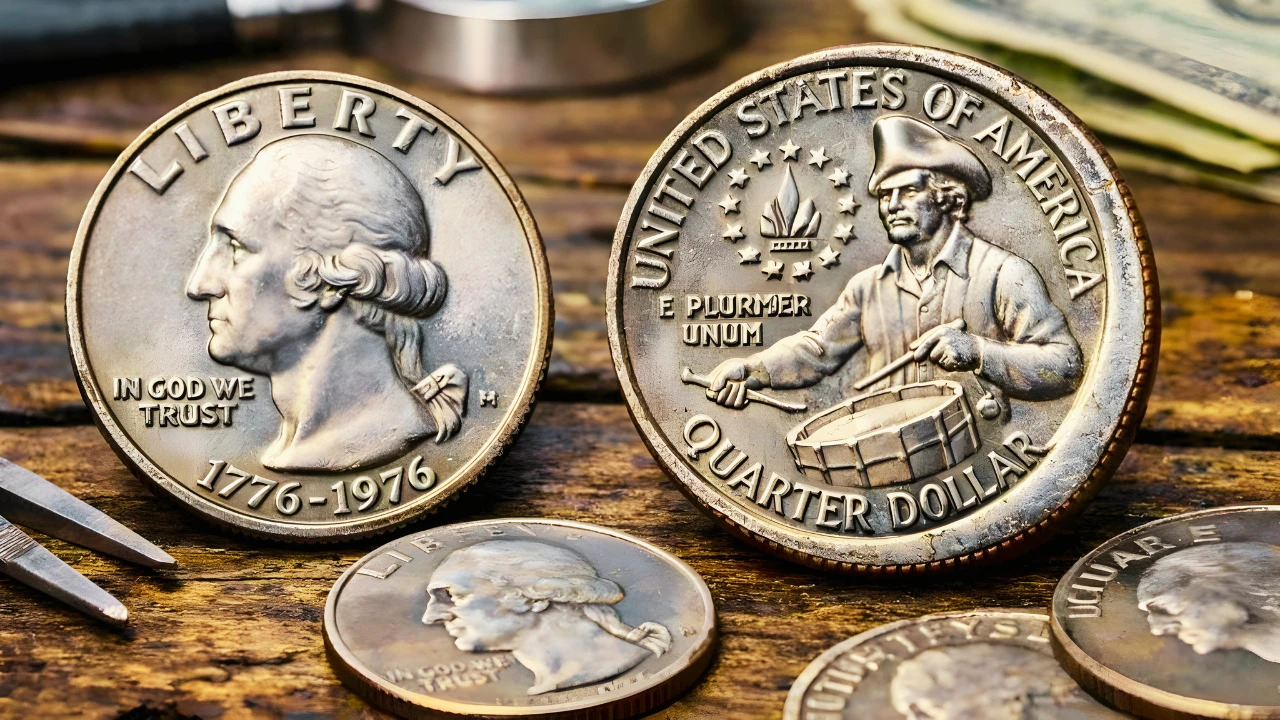
Rare Bicentennial Quarter Errors in 2026: The Bicentennial Quarter Error Guide 2026 provides information regarding one of the most widely discussed U.S. coins that remains in circulation today. Originally minted with the dual date 1776–1976, this coin commemorated America’s bicentennial and featured a unique drummer design. Although billions of these coins were produced, only a small fraction possess the valuable mint errors that continue to captivate serious collectors in 2026.
Understanding these errors is crucial because, while the majority of these coins retain only their face value, certain rare varieties can command prices ranging from hundreds to thousands of dollars, depending on their condition and rarity.
Historical Background of the Coin
The Bicentennial Quarter distinguishes itself from standard Washington quarters through its unique reverse design and dual-date inscription. In place of the traditional eagle, this coin features a colonial drummer—a symbol of the American Revolution. This visual departure has established it as one of the most easily recognizable coins in American history.
These coins were produced on a massive scale, which is why the majority of them remain commonly available today. However, specific factors—such as minting errors, silver composition, and exceptional preservation—have created a specialized market where, despite their initial mass production, certain individual coins are considered highly valuable.
Basics of Minting Errors
Minting errors occur when a malfunction arises during the coin production process. These errors can range from misaligned strikes and die defects to anomalies in the metal composition; collectively, these factors result in unique variations within the coin. Collectors value these coins precisely because every error represents a deviation or departure from the standard coin-minting processes.
Within the Bicentennial Quarter series, error coins are highly sought after because they are significantly scarcer compared to the vast quantities of standard coins in circulation. The rarity of these errors—combined with their unique visual characteristics—directly influences their market value in 2026.
Common Error Types
While various types of errors are frequently observed in Bicentennial Quarters, only those that are clearly visible are generally considered to be of significant value. “Doubled die errors” are among the most popular; these occur when a misalignment of the die during the striking process causes letters or numerals to appear duplicated.
“Off-center strikes” constitute another major category; in these instances, the coin’s design fails to register correctly, leaving a portion of the coin’s surface blank. Additionally, errors such as “clipped planchets,” “missing clad layers,” and “die cracks” are also encountered; the role each of these errors plays in rendering a coin collectible depends largely on its visual clarity and severity.
Rare Error Types
In the collector’s market, more extraordinary and scarce errors typically command higher prices. For instance, instances of missing edge lettering have been reported in modern commemorative coins; once such errors are authenticated, their market value can appreciate significantly.
Other rare error types include coins struck on incorrect metal blanks (planchets) or those exhibiting a “die clash”—a collision between the dies so forceful that it leaves a faint, ghost-like impression on the coin’s surface. These errors are typically detected early on and certified by grading services; this validates their authenticity and increases their demand among collectors.
Value Comparison Table
The table below illustrates the estimated values for Bicentennial Quarter errors in 2026, based on type and condition:
| Error Type | Value in Average Condition | Value in High Grade |
|---|---|---|
| Doubled Die | $150 – $500 | $1,500+ |
| Off-Center Strike | $100 – $400 | $1,500+ |
| Clipped Planchet | $20 – $150 | $300+ |
| Missing Clad Layer | $150 – $250 | $500+ |
| Die Clash / Cud | $50 – $200 | $1,000+ |
These ranges can vary significantly based on visual clarity and professional grading. Certified coins in high grades often fetch substantially higher prices at auctions.
The Role of Condition
Condition plays a crucial role in determining the value of any Bicentennial Quarter error. Coins graded at high levels—such as MS67 or higher—are rare, as most coins saw heavy circulation following their release.
Collectors prioritize coins that exhibit sharp details, minimal wear, and strong luster. Even a coin with a common error can become highly valuable if it has been preserved in near-perfect condition; this is why grading remains one of the most critical factors in the 2026 coin market.
Market Demand Trends
Driven by growing interest in collectible U.S. coins, the demand for Bicentennial Quarter errors has seen a steady increase in 2026. Modern collectors are particularly drawn to visually appealing errors that can be easily identified without the need for specialized equipment.
Another factor influencing demand is the broader trend toward alternative investments. Coins possessing verified rarity and historical significance are now being viewed not merely as collectibles, but also as long-term assets—a trend that is driving the prices of premium coins steadily upward.
Final Value Insights
Despite attracting widespread attention, it is crucial to understand that not all Bicentennial Quarter coins are valuable. The majority remain common coins worth only twenty-five cents, and claims of extremely high values typically apply only to rare, verified error coins.
True value lies in rarity, condition, and authenticity. Coins featuring distinct and well-documented errors—and which have received professional certification—consistently outperform the market; this is why these specific coins within the ‘Bicentennial’ series are considered the most sought-after today.