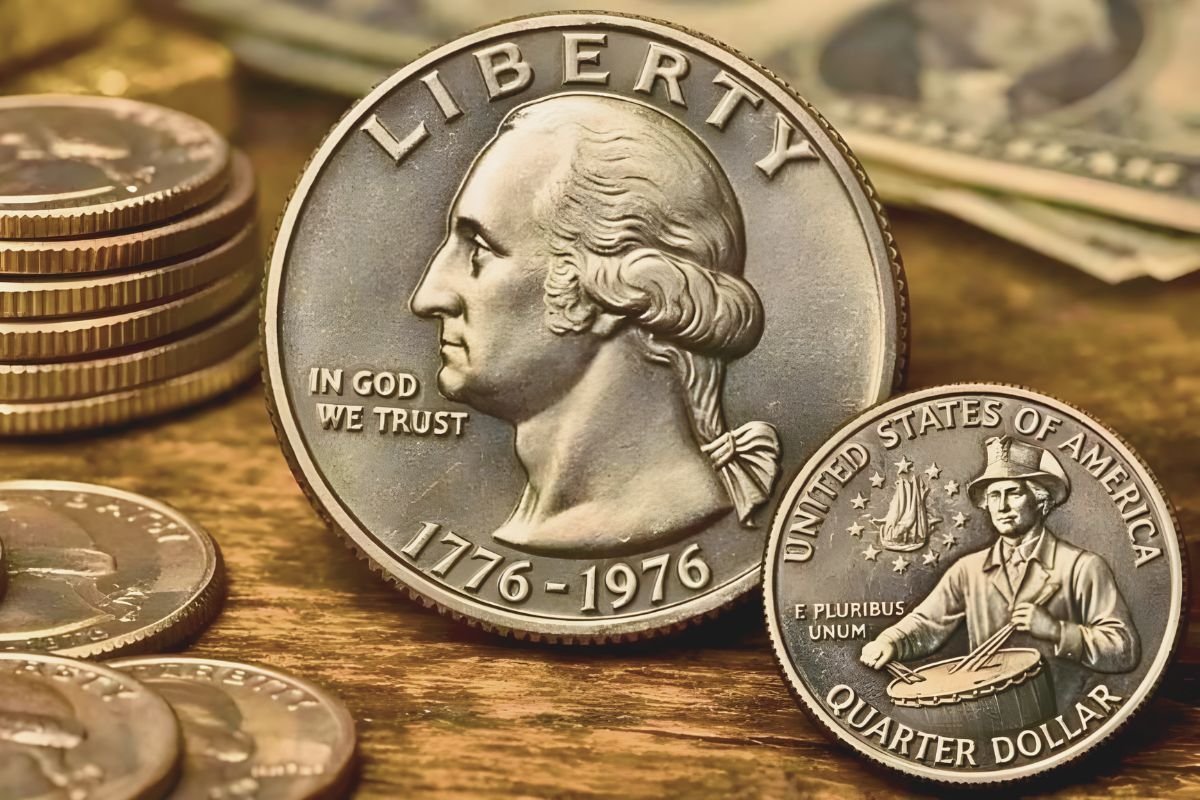
The rare 1776–1976 Bicentennial Quarter stands as one of the most recognizable commemorative coins in American history. Minted to celebrate the 200th anniversary of the Declaration of Independence, these quarters feature a unique dual-date design and a distinctive reverse side depicting a colonial drummer. However, while millions of these coins were produced for general circulation, certain rare varieties and specific conditions have rendered some Bicentennial Quarters extremely valuable to coin collectors today.
Production and Design Background
The United States Mint produced Bicentennial Quarters at three locations between 1975 and 1976. The Philadelphia, Denver, and San Francisco mints collectively issued over 1.6 billion quarters for general circulation, making them a common sight in everyday transactions. The reverse design, created by Jack L. Ahr, replaced the traditional eagle motif with an image of a Revolutionary War-era drummer boy, while the obverse retained the portrait of George Washington, accompanied by a special dual date that commemorated both the original year of independence and the Bicentennial celebration.
Current Values of Circulated Coins
Most Bicentennial Quarters found in pockets or coin rolls are worth no more than their face value. Quarters minted in Philadelphia (without a mint mark) and those minted in Denver (bearing the “D” mint mark) typically trade for 25 cents, unless they possess specific distinguishing characteristics. Circulated coins showing normal signs of wear from everyday use are available in the market in vast quantities; coin dealers often decline to purchase them at a premium due to this oversupply.
Specialized Values for Uncirculated Coins
Quarters that never entered general circulation—and whose surfaces remain in pristine, like-new condition—command significantly higher prices in the numismatic market. Such coins from the Philadelphia and Denver mints, having never circulated, can sell for anywhere between three and eight dollars, depending on their specific grade and aesthetic appeal. Professional grading services like PCGS and NGC assign numerical grades to these coins; those graded MS-65 exhibit minimal contact marks and possess exceptional luster, making them highly desirable to serious collectors seeking high-quality specimens.
Specialty Silver-Composition Coins
The San Francisco Mint produced special editions for collectors, utilizing a composition containing 40 percent silver rather than the standard copper-nickel alloy. These silver Bicentennial quarters were not released into general circulation; instead, they were sold directly to collectors as part of special mint sets and “Proof sets.” Uncirculated silver quarters typically range in value from eight to fifteen dollars, with the intrinsic value of the metal itself—based on current market silver prices—establishing their minimum floor price.
Proof Quarters: The Collectibility Factor
San Francisco Proof Bicentennial quarters feature mirror-like surfaces and frosted design elements created through a specialized minting process. Standard clad Proof coins in pristine condition typically sell for five to twelve dollars, offering collectors an affordable way to acquire a flawless specimen of the commemorative design. “Deep Cameo” Proofs—characterized by an extreme contrast between the background fields and the raised design elements—can fetch prices exceeding twenty dollars when professionally certified in high grades.
Error Coins Command High Prices
Manufacturing errors occurring during production have given rise to valuable error varieties that attract expert collectors willing to pay substantial premiums. Double-die errors—where design elements are duplicated due to hub alignment issues—can fetch up to several hundred dollars, depending on the prominence and placement of the doubling. Off-center strikes, incorrect planchet errors, and broadstrike examples also hold significant value, with some specimens selling for over a thousand dollars at auction when the error creates a dramatic visual effect.
Bicentennial Quarter Value Comparison
| Type | Composition | Condition | Typical Value Range |
|---|---|---|---|
| Philadelphia/Denver Circulation | Copper-Nickel Clad | Circulated | $0.25 |
| Philadelphia/Denver Circulation | Copper-Nickel Clad | Uncirculated MS-65 | $3 – $8 |
| San Francisco Silver | 40% Silver | Uncirculated MS-65 | $8 – $15 |
| San Francisco Proof | Copper-Nickel Clad | Proof-65 | $5 – $12 |
| San Francisco Proof | 40% Silver | Proof-69 Deep Cameo | $15 – $35 |
| Major Error Varieties | Varies | Any Grade | $100 – $2,000+ |
High-Grade Rarity Influences the Market
Bicentennial quarter coins graded MS-67 or higher—particularly those within registry sets—become truly rare and highly desirable among collectors. These exceptional coins retain their original luster, exhibit virtually no bag marks, and possess a minting quality so superb that they stand apart from standard obsolete coinage. Auction records indicate that MS-67 grade quarters sell for between $40 and $70, while MS-68 grade coins fetch upwards of $200 when competitive bidding for these rare pieces intensifies.
The Allure of Silver Proof “Deep Cameo”
Among Silver Proof Bicentennial quarters, the “Deep Cameo” designation significantly impacts value compared to the standard Proof finish. Coins graded PR-69 Deep Cameo offer not only technical perfection but also stunning visual contrast, showcasing the “Drummer Boy” design against a brilliant, mirror-like surface. These premium coins regularly sell for between $25 and $40, while flawless PR-70 grade examples occasionally appear in specialized auctions, where they can command prices of $100 or more.
Authentication Prevents Costly Mistakes
Counterfeit Bicentennial quarters exist in the market—specifically those where common circulating coins have been subjected to artificial toning or surface treatments to mimic the appearance of valuable specimens. Third-party grading services provide authentication that protects collectors from purchasing fakes while simultaneously establishing standards for quality assessment. The encapsulation process also shields the coins’ surfaces from environmental damage and the wear and tear of handling, factors that could otherwise diminish their future value.
Market Demand Remains Steady
Collector interest in Bicentennial quarter coins remains steady, driven by both nostalgia and historical significance. Many Americans cherish memories of receiving these distinctive coins during their childhood, fostering an emotional connection that continues to inspire them to treasure these pieces decades later. Their commemorative nature appeals to history enthusiasts alongside traditional numismatists, while the challenge of assembling complete sets—including all mint marks and varieties—offers an accessible goal for amateur collectors.