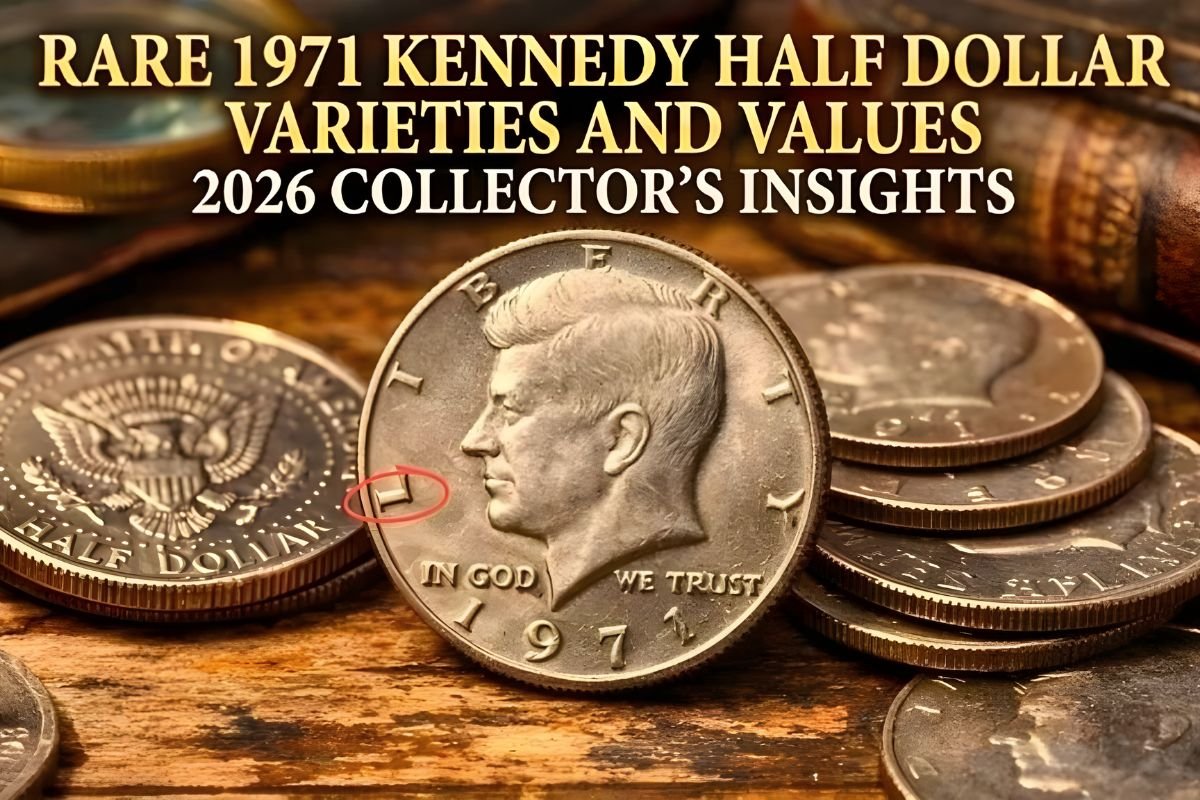
The 2026 Kennedy Half Dollar marks the continuation of one of America’s most iconic coin series, which has been minted since 1964. As collectors and investors look toward new releases, understanding the potential value of these coins becomes essential for making informed decisions. The 2026 edition upholds the legacy of President John F. Kennedy while simultaneously offering new opportunities for numismatic enthusiasts across the United States.
Current Market Status
The 2026 Kennedy half dollar enters circulation at a time when coin collecting is witnessing renewed interest among both younger generations and traditional collectors. General circulation coins issued by the Philadelphia and Denver Mints typically carry a face value of fifty cents when used in commercial transactions. However, uncirculated examples and special mint sets command a premium ranging from three to eight dollars, depending on their condition and mint mark.
Collectors should note that modern Kennedy Half Dollars rarely enter widespread circulation; this means that most coins remain in better condition compared to those bearing earlier dates. The 2026 editions available through official United States Mint channels are of superior quality compared to the coins released into general circulation via Federal Reserve Banks.
Types of Mint Marks
The 2026 Kennedy Half Dollar is available in three main varieties, distinguished by their production facility. Coins from the Philadelphia Mint bear the ‘P’ mint mark and represent the largest production run intended for general circulation purposes. Coins from the Denver Mint feature the ‘D’ mark and are distributed through similar channels to the western states and beyond.
The San Francisco Mint produces ‘Proof’ versions bearing the ‘S’ mint mark; these feature mirror-like surfaces and frosted design elements—qualities highly prized by serious collectors. These Proof coins are sold exclusively through special sets and never enter general circulation, thereby preserving their pristine, original condition from the moment of production until they reach the hands of a collector.
Analyzing the Impact of Grading
Professional grading services evaluate the Kennedy Half Dollar on a numerical scale ranging from 1 to 70, with higher numbers indicating a superior state of preservation. Under current market conditions, a 2026 coin graded MS-65 (Mint State 65) typically sells for approximately five to seven dollars. Coins achieving a grade of MS-67 or higher can command prices ranging from fifteen to twenty-five dollars, owing to their exceptional aesthetic appeal and minting quality.
While the difference in grade may appear subtle to the casual observer, collectors are willing to pay a significant premium for coins that are free of contact marks, possess full original luster, and feature sharp, distinct designs. Even a single-point difference in the numerical grade can result in a substantial shift in the value of gem-quality coins.
Special Editions
In addition to standard circulation coinage, the U.S. Mint produces enhanced versions designed for collectors willing to pay a premium price. Unlike the copper-nickel clad composition used for regular circulation coins, silver proof Kennedy half dollars contain 90% silver. These 2026 Silver Proof coins typically retail directly from the mint for thirty to forty-five dollars.
Kennedy Half Dollars are sometimes included alongside coins of other denominations in limited-edition sets featuring special packaging or commemorative themes. Such sets often offer a value proposition that exceeds the aggregate value of the individual coins contained within—particularly when production figures remain relatively low compared to the level of market demand.
Condition Preservation Factors
2026 Kennedy Half Dollars best retain their value when properly stored, away from environmental hazards. Coins exposed to moisture, extreme temperatures, or chemical cleaning lose significant value compared to those that remain unaltered. Collectors should handle coins only by their edges and store them in holders specifically designed for numismatic preservation.
2026 half dollars that have entered circulation—exhibiting signs of wear on Kennedy’s cheek and the eagle’s breast feathers—typically revert to face value, regardless of the mint mark. The transition from uncirculated to circulated status represents the most significant depreciation in value for any modern coin.
Market Value Comparison
| Coin Type | Mint Mark | Grade | Approximate Value |
|---|---|---|---|
| Circulation Strike | P or D | MS-63 | $3 – $5 |
| Circulation Strike | P or D | MS-65 | $5 – $7 |
| Circulation Strike | P or D | MS-67 | $15 – $25 |
| Proof Strike | S | PR-69 | $8 – $12 |
| Silver Proof | S | PR-69 | $30 – $45 |
| Circulated | Any | Good-VF | $0.50 |
Long-Term Investment Potential
Compared to previous series, the 2026 Kennedy Half Dollar faces certain challenges from an investment perspective. Modern production techniques ensure uniform quality across millions of coins, thereby diminishing rarity and dampening collector demand. Unlike the silver coins of 1964 or the low-mintage issues of the 1970s, recent years have seen an abundant supply, which has limited the potential for significant price appreciation.
Collectors focused on completing registry sets or building type collections find the 2026 coins useful for filling gaps in their collections without requiring a substantial financial investment. These coins also serve as valuable tools for young collectors learning to identify grading standards and recognize mint marks.
The Legacy of Design Elements
The obverse of the 2026 Kennedy Half Dollar features Gilroy Roberts’ portrait of President Kennedy, facing left, with the inscription “LIBERTY” arching above. The reverse—featuring a heraldic eagle designed by Frank Gasparro—has remained unchanged since 1964, offering a sense of consistency that appeals to collectors. These design elements link modern coinage to the coin’s historical origins during a pivotal era of American history.
Subtle variations arise in each coin due to minor differences in die polishing or striking pressure, offering collectors the opportunity to seek out the most aesthetically pleasing specimens. This type of variation adds an element of intrigue even to a standardized modern coin.