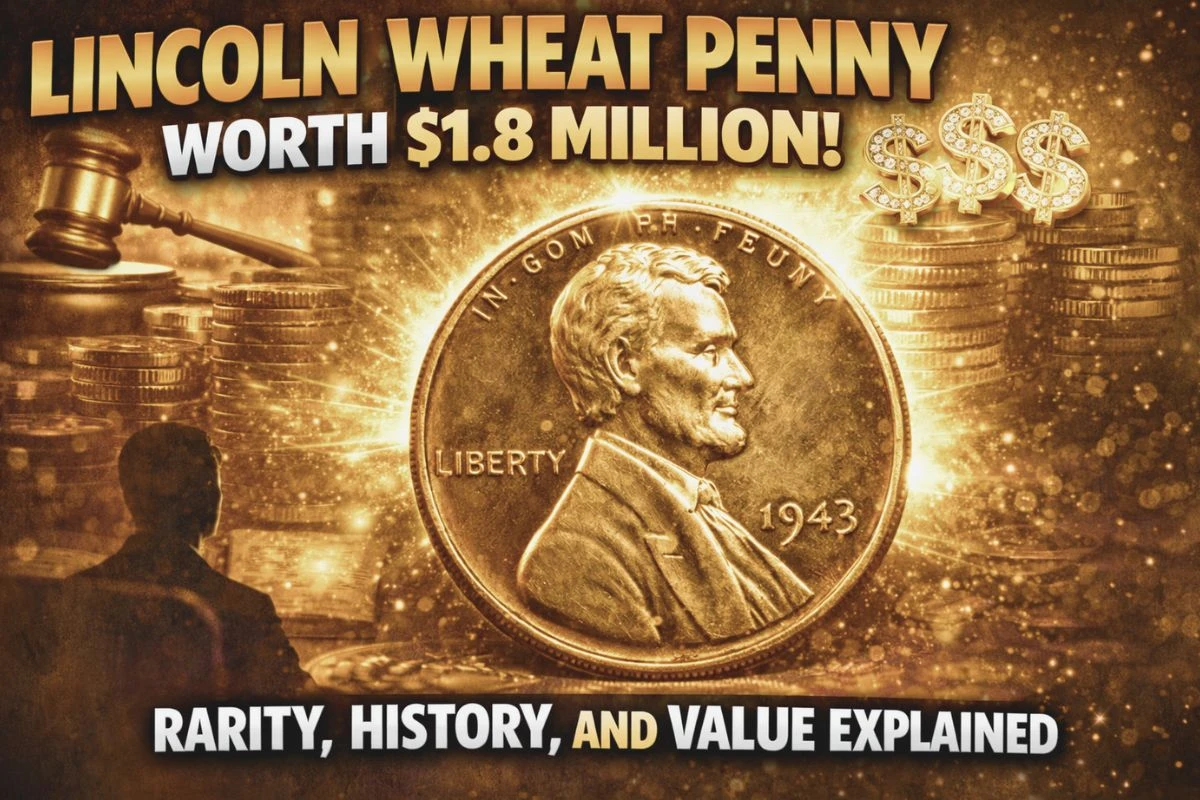
Lincoln Wheat Penny Worth $1.8 Million: Valued at $1.8 million, the Lincoln wheat penny stands as one of the most extraordinary discoveries in the history of American numismatics. Minted in 1943, this exceptional coin serves as living proof of how a minor minting error can transform an ordinary object into a treasure worth far more than most people’s homes. The story behind this penny captivates both coin collectors and the general public alike, demonstrating that fortune sometimes lies hidden in the most unexpected places.
Explaining the Bronze Error
During World War II, the United States faced a severe copper shortage, as the metal was in critical demand for ammunition and military equipment. In 1943, the U.S. Mint began utilizing zinc-coated steel to produce pennies, resulting in distinct, silver-colored coins that year. However, a few bronze planchets (coin blanks) from 1942 remained lodged within the machinery and were inadvertently struck with the 1943 date. This error gave birth to a unique rarity that would eventually become a legend among coin collectors.
Rarity Beyond Imagination
Today, only 10 to 15 authentic bronze Lincoln pennies from 1943 are known to exist, making them incredibly rare. This rarity is the primary driver behind their skyrocketing value, as collectors engage in fierce competition to acquire these unique historical artifacts. The convergence of wartime history, a minting error, and extreme rarity creates an irresistible allure surrounding these coins, driving their market value into the millions.
Record-Breaking Sales Statistics
This $1.8 million valuation is grounded in actual sales records—instances where these coins have changed hands among serious numismatists. In recent years, coins in exceptional condition have been auctioned at major auction houses, with their prices shattering all previous records. The condition of the coin—referred to as its “grade”—plays a pivotal role in determining whether a 1943 bronze penny will fetch hundreds of thousands or soar to a seven-figure (million-dollar) valuation.
Challenges in Verifying Authenticity
Determining whether a 1943 penny is composed of genuine bronze or is a counterfeit created by altering a steel penny requires expert analysis and specialized equipment. Numerous attempts have been made to fabricate fakes by plating 1943 steel pennies with copper, making the verification of a coin’s authenticity absolutely essential. Professional grading services employ precise weight measurements, metallurgical testing, and microscopic examination to verify a coin’s authenticity; this is because a genuine bronze penny weighs approximately 3.11 grams, whereas its steel counterpart weighs 2.7 grams.
Historical Context Matters
The error resulting in the 1943 bronze penny occurred during one of America’s most challenging periods, thereby elevating its historical significance far beyond its mere numismatic value. These coins serve as a tangible reminder of a moment when the entire nation united for the war effort—a time when even the production of a simple penny reflected the sacrifices and resource allocation of that era. Collectors value not only the rarity of these coins but also the profound historical connection that each specimen establishes with the history of World War II.
Comparison with Other Errors
| Coin Error Type | Estimated Value | Known Specimens | Year Minted |
|---|---|---|---|
| 1943 Bronze Penny | $1.8 Million | 10–15 | 1943 |
| 1944 Steel Penny | $375,000 | 15–20 | 1944 |
| 1955 Double Die Penny | $125,000 | Thousands | 1955 |
| 1969-S Doubled Die Penny | $85,000 | 40–50 | 1969 |
The Discovery Experience
Most 1943 bronze pennies were discovered by chance; they were often found in circulation decades after they were minted. Some were identified by sharp-eyed individuals who noticed their unique color among the coins they possessed, while others surfaced from inherited coin collections. The possibility that more specimens may still be hidden in old jars or forgotten collections keeps hope alive among treasure hunters and further heightens the mystique surrounding these coins.
The Dynamics of Market Demand
The market for extremely rare coins—such as the 1943 bronze penny—operates differently than the general market for collectibles. Wealthy collectors, museums, and institutions compete to acquire these coins, creating a market where supply is limited, yet demand is virtually limitless. Auction results demonstrate that serious bidders are willing to pay exorbitant prices for coins with an impeccable provenance and in pristine condition; this trend ensures that the value of these coins continues to rise steadily.
The Importance of Preservation
Coins valued in the hundreds of thousands or millions are typically accorded the kind of security and storage facilities found in museums. Professional grading services encapsulate certified specimens within protective holders; these holders shield the coins from environmental damage while simultaneously allowing for their complete visual inspection. The difference in value between a well-preserved coin and one that has suffered damage or undergone cleaning can amount to millions of dollars; consequently, the proper handling and storage of coins are of paramount importance.
The Investment Perspective
While the 1943 bronze penny offers a tremendous return on investment to any fortunate individual who possesses one, it also serves to validate a broader principle: the value of rare coins can appreciate very rapidly over time. The confluence of historical significance, proven rarity, and the deep passion collectors harbor for these coins creates a market where prices consistently trend upward. Over the past few decades, these coins have outperformed many traditional investments by a wide margin—a fact that has begun to attract serious investors, in addition to traditional numismatists.
Future Value Projections
Experts predict that the value of certified 1943 bronze pennies will continue to rise, as wealthy collectors vie to acquire these “ultimate trophy” coins. Given the limited supply of these coins and the growing wealth among collectors, it appears that the $1.8 million mark may well represent a “baseline” rather than a “ceiling.” As time passes—and as these coins become even rarer due to loss or permanent placement within museum collections—the prices fetched by the remaining specimens at auction could reach even more extraordinary levels.