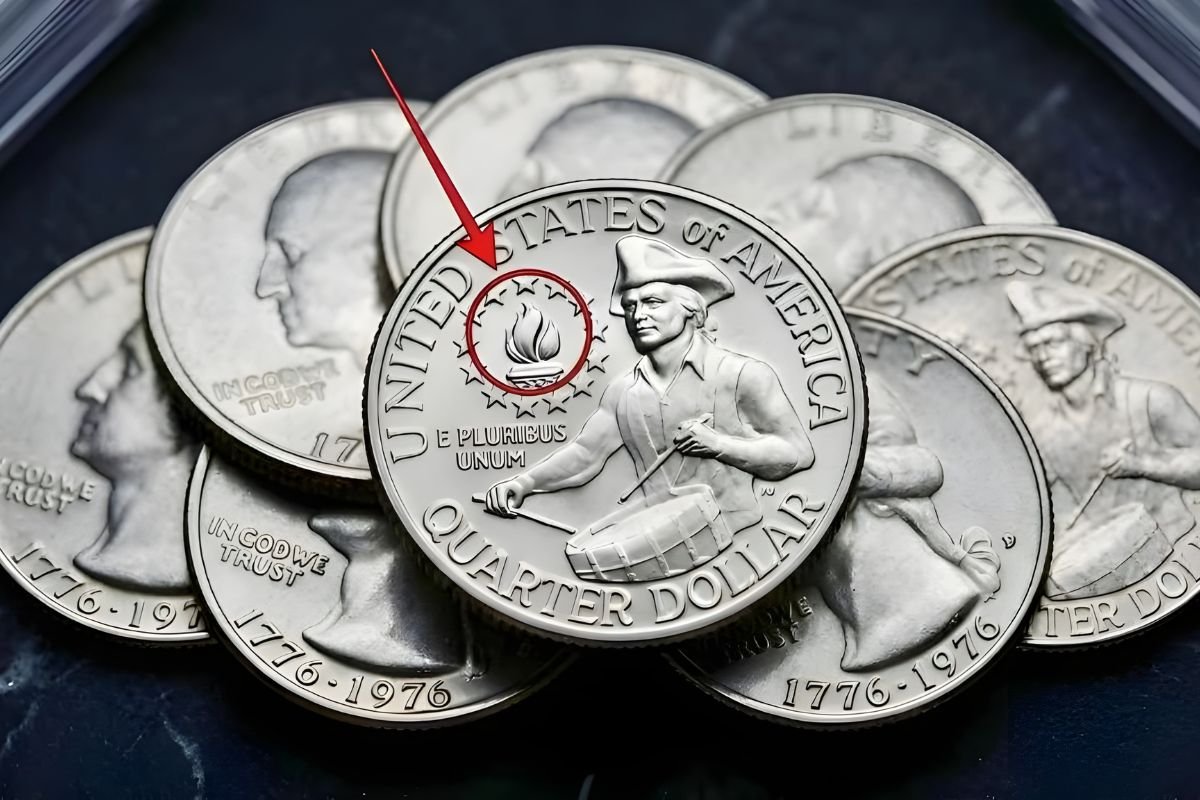
1976 Drummer Boy Quarter Value: The 1976 “Drummer Boy” Quarter—officially known as the Washington Quarter Bicentennial Edition—holds a special place in the history of American numismatics. This commemorative coin was minted to celebrate the 200th anniversary of the United States’ Declaration of Independence. Its reverse side features a design of a colonial drummer boy created by Jack L. Ahr, which replaced the traditional eagle motif that had appeared on quarters since 1932. Both dedicated collectors and casual coin enthusiasts continue to search through their loose change today in hopes of discovering these distinctive coins, often speculating on their potential market value.
Minting and Production Figures
The United States Mint produced a massive quantity of Bicentennial quarters across three different facilities during 1975 and 1976. The Philadelphia Mint struck over 809 million quarters bearing no mint mark, while the Denver facility produced approximately 860 million coins featuring the “D” mint mark. The San Francisco Mint produced special proof editions specifically for collectors, totaling approximately 7 million coins bearing the “S” mint mark. Due to this extensive production volume, most coins found in general circulation today are considered common; however, certain specific varieties and coins in exceptional condition command premium prices among serious collectors.
Value in Circulated Condition
Most 1976 “Drummer Boy” quarters found in everyday circulation are worth no more than their face value of 25 cents. Coins exhibiting typical wear, scratches, or discoloration usually sell for their face value—or very close to it—unless they possess some unusual distinguishing feature. Even coins in slightly better-than-average condition rarely fetch more than 50 to 75 cents when sold to dealers or collectors. Despite their historical significance and distinctive colonial drummer design, the sheer abundance of these coins in the market prevents them from commanding a significant premium.
Uncirculated and Mint State Coins
Quarter coins that never entered circulation and retain their original luster possess a distinct value. Coins graded as “Mint State 65” by professional grading services typically sell for between $5 and $8, depending on market conditions. Higher-grade specimens—reaching levels of MS67 or above—can fetch prices ranging from $25 to $150 among discerning collectors. The copper-nickel clad versions produced in Philadelphia and Denver are the most affordable, while exquisite specimens featuring exceptional eye appeal and fine details command the highest prices.
Silver Composition Varieties
The San Francisco Mint produced special 40% silver versions of the Bicentennial Quarter exclusively for collector sets. Unlike the standard circulating coins, these feature a silver-clad composition rather than the copper-nickel layers typically used. Proof versions—retained in their original packaging—generally sell for between $8 and $12 in average grades, whereas highly lustrous (deeply mirrored) coins graded PR69 or PR70 can be valued anywhere from $50 to $200. The mere presence of silver endows these coins with an intrinsic value exceeding that of their copper-nickel counterparts, making these varieties—regardless of their specific numismatic condition—consistently more desirable.
Error Coins and Varieties
Minting errors and die varieties can significantly enhance the value of otherwise common Bicentennial Quarters for specialists and collectors actively seeking such unique specimens. Double die errors—characterized by a visible doubling of letters or design elements—can fetch anywhere from $100 to $500, depending on the severity of the doubling and its clarity. Off-center strikes—in which the design is not properly aligned on the coin’s blank piece (planchet)—can command prices ranging from $50 to several hundred dollars, depending on the degree of off-centering. Errors involving an incorrect planchet—where the design is struck onto a blank piece intended for a coin of a different denomination—represent some of the rarest and most valuable examples in the field.
Market Demand Factors
Collector interest in Bicentennial coins fluctuates based on broader numismatic trends and the cycles of significant historical anniversaries. As key historical milestones approach—such as the 250th anniversary of American independence in 2026—demand for numismatic items featuring themes from the Revolutionary War era typically rises. Young collectors new to the hobby often select these readily available and historically significant coins as their entry point into coin collecting. However, their vast availability in the secondary market ensures that only the finest examples—or those that are genuinely rare—tend to appreciate significantly in value over time.
Impact of Grading on Value
Professional third-party grading has a significant impact on the market saleability and price of 1976 “Drummer Boy” quarter coins that are in a condition superior to average circulation. Certification by major grading services—such as PCGS or NGC—ensures an expert assessment of a coin’s authenticity and condition, thereby instilling confidence in buyers. Grading costs typically range from $20 to $40 per coin; consequently, it is economically viable only for coins graded MS66 or higher. Ungraded coins—even those that appear to be in pristine mint condition—typically sell for lower prices than certified coins, as buyers are unable to independently verify their true condition.
Collector vs. Investor Perspectives
Numismatists who collect coins for personal enjoyment rather than for financial gain often find Bicentennial quarters appealing for historical and aesthetic reasons, regardless of their monetary value. These collectors appreciate the unique design—produced for a single year only—and its connection to America’s Bicentennial celebrations. Investment-minded buyers, conversely, typically avoid Bicentennial quarters with common dates, unless they are acquiring high-grade specimens or verified error coins that hold potential for future appreciation. The distinctive dual dating (1776–1976) and the imagery of the “Drummer Boy” evoke a sense of nostalgic charm for many enthusiasts that transcends purely financial considerations.
Value Comparison Table
| Condition/Type | Mint Mark | Approximate Value Range |
|---|---|---|
| Circulated | P, D | $0.25 – $0.75 |
| MS63-64 | P, D | $2 – $4 |
| MS65-66 | P, D | $5 – $15 |
| MS67+ | P, D | $25 – $150 |
| Proof Silver | S | $8 – $12 |
| High-Grade Proof | S | $50 – $200 |
| Major Error | Any | $100 – $500+ |
Long-Term Outlook
The future appreciation in value of the 1976 “Drummer Boy” quarter coins remains uncertain, given their extremely high mintage figures and their consistent availability at estate sales and coin shops. While their numbers are gradually diminishing due to loss or damage—thereby creating the potential for value appreciation over the course of several decades—it is unlikely that coins in general circulation or those in average, circulated condition will experience any significant increase in value. Collectors should acquire these coins primarily for their historical significance, rather than with the expectation of funding retirement accounts or generating substantial investment returns.